
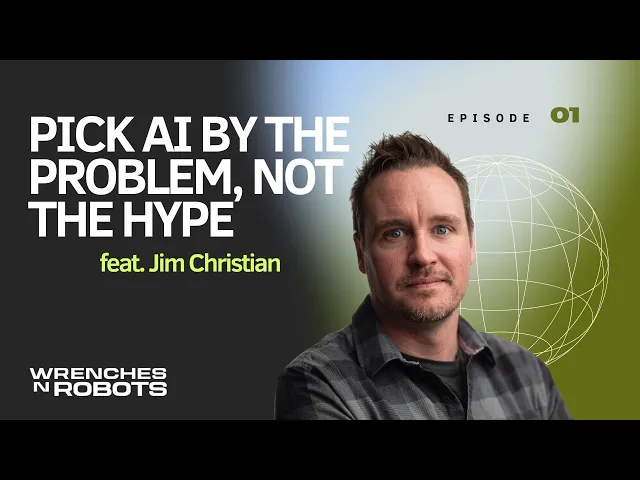
AI Agents for HVAC Businesses: What Actually Works
Summary
Tersh Blissett opens his new show, Wrenches n Robots, with Jim Christian, Senior Director of Product at Podium, for a no-hype look at where AI actually earns its keep in an HVAC, plumbing, or electrical shop. Jim breaks down why the value of AI sits in the application layer rather than in the underlying model, walks through what an AI agent really is using Podium's AI membership coordinator as the example, and lays out where voice AI belongs after hours and during call overflow, and where forcing it everywhere can hurt a brand.
The conversation moves from Jim's own "AHR Expo moment," when a crowd that tuned out a talk on AI leaned back in the second he showed a Zapier slide, through Podium's three AI employees, the CSR, the membership coordinator and Operator, and into real numbers from hundreds of thousands of analyzed phone calls. For dealers and owners in the trades, it is a practical primer on judging any AI tool by the problem it solves and the return it delivers, with Podium's own build-out as the working case study.
Key takeaways
Podium's AI membership coordinator took a roughly 1,000-member HVAC contractor off paper agreements and weeks-long manual calling, putting renewal scheduling on autopilot so the office manager could focus on growing the membership base instead.
Speed to lead remains decisive: Jim notes that if a home services business doesn't respond within five minutes, the chance of winning that lead can drop by 90% or more, which is why Podium built always-on AI employees to answer first.
After testing AI-staffed calls against human-staffed calls, Podium found hang-up rates were statistically the same, roughly 20% on inbound, suggesting most hang-ups are wrong numbers or spam rather than rejection of AI itself.
About the Host & Guests

Host
Tersh Blissett
Co-host, Service Business Mastery; Host, Wrenches n Robots
Tersh Blissett co-hosts the Service Business Mastery podcast with Josh Crouch and hosts Wrenches n Robots, a show on AI and automation for home service businesses. He has owned and operated an HVAC and plumbing company near Savannah, Georgia, since 2014, co-founded Trade Automation Pros, and helped build PhoneTAP, a call-analysis and coaching tool for the trades.
Guest
Jim Christian
Senior Director of Product, Home Services, Podium
Jim Christian is a Senior Director of Product at Podium, where he leads the product team building Podium's AI Operating System for Home Services. He previously led Podium's payments product, working on tools such as text-to-pay for small businesses. He is based in Utah.
Timestamped Chapter Markers
00:02 – Introduction
00:36 – Meet Jim Christian of Podium
03:22 – Why AI won't replace your team, but competitors using AI will
05:34 – The AHR Expo moment: when "AI" was really just automation
09:27 – Inside Podium's AI membership coordinator
12:09 – What is an AI agent, really?
14:50 – Where voice AI belongs, and where it backfires
17:02 – Hang-up rates, sentiment and the PhoneTap data
20:52 – Inside Podium's AI Studio: training and feedback loops
23:38 – Personal AI agents and owning your own data
29:08 – Speed to lead and the birth of Podium's AI employees
31:53 – Meet Operator, Podium's back-office AI agent
34:04 – Turning reporting into marketing ROI and live dashboards
35:39 – How Operator fixed a technician job-notes problem
Who is Jim Christian, and what does Podium do in home services?
Jim Christian: You're not going to lose your job to AI. You're going to lose your job to somebody else with AI. There are plenty of AI companies thinking about how to do full human replacement, and what I push on our team is let's focus on turning people at these companies into superhumans with AI, not focus on replacing them. So we built a full operating system platform that's not just the front office communication layer anymore. It's a full field service management software under the hood: price book, membership programs, the technician mobile app, the entire stack. The third one that is honestly the most exciting to me, we call it the Podium Operator. Imagine you had another employee or assistant in your office that could do work for you when you need them to. He has skills, a very human-readable playbook of how I should operate in these scenarios.
Tersh Blissett: I am excited to have you on the show today, Jim. Tell me who you are, what's your role. He's a friend of mine that I've had for so many years now, and literally I could text him anything and he's like, "Dude, you got to check this out, we're doing this new awesome thing." Back whenever AI voice was coming out a while back, I saw him at a trade show and he's like, "Dude, you got to check this out, this is awesome." Podium's been in the forefront of the thought leaders when it comes to AI in general for me. Every time I go to a trade show, Podium's got something cool to talk about and new. Share a little bit about yourself and then what Podium's got going on.
Jim: Yeah, yeah, thanks, Tersh. Well, first of all, thanks for having me here, this is awesome, really excited to talk to you a little bit. Heard a lot about you over the last 12 months or so since I've really started focusing on home services specifically and applying our platform to that industry, and so I'm just super excited to be here to talk about it. By way of introduction, I'm a Senior Product Director here at Podium. My main responsibility is building our entire AI operating system for home service businesses. We started that journey, started talking about it about 24 months ago, and got building shortly after that. That's kind of my role here. I also handle a few other areas of our product, like our payments product, but that ultimately just serves what we're doing here for HVAC businesses.
Why won't AI take your team's jobs?
Tersh: As far as AI in the trades for contractors, what's your thoughts on that? Because for me, when AI was first introduced to the masses, a lot of people were terrified that it was going to take over everything. The CSRs were worried they were going to get rid of all your CSRs, and technicians hated it. Loved it or hated it. There are products out there, something like Rilla or Siro for the technicians, and I introduced that into one of my businesses, and at first the technicians were super anti. "I don't want Big Brother listening to me" type thing. Then I explained to them how it would help them, and they kind of picked up, they were like, "Okay, I'm cool with that." I like that it helps me learn how to become better without you having to do a ride-along necessarily. So in some instances I'm seeing contractors loving it, and I'm seeing some that are still really hesitant toward it. What's your take on it?
Jim: Yeah, I think that's a great question. I have a lot of thoughts on this. Number one, there's the famous quote, I'm sure you've heard it: you're not going to lose your job to AI, you're going to lose your job to somebody else with AI. I think that holds more true now than ever, and I think there were plenty of AI companies thinking about how to do full human replacement. My personal model, and what I push on our team, is let's focus on turning people at these companies into superhumans with AI, not focus on replacing them. There are pockets where you can talk about human labor efficiency, a good AI CSR working over both voice and text could replace the need for a call center, those kinds of things, but for the most part, nearly all of the AI we're building allows the customers we work with to focus on how they can do more and work on the business rather than doing the tedious stuff that happens day to day. I think that's really important. The user reception to AI and the fear of it up front isn't even necessarily about losing the job, it's "I'm not sure if I want this thing listening to me." I think that's very natural with a new technology, there's a lot of fear about what it might do. What really matters is that the AI you're using actually provides meaningful benefit to you. So when we talk about how you go about picking an AI vendor to work with, for me it always starts with: what is my actual problem I'm trying to solve,
Tersh: Yes.
Jim: and what's my return on investment on buying this AI product? Is it actually going to solve that problem, or is it just a buzzword?
The AHR Expo moment: when "AI" was really just automation
Tersh: There are so many times where I'm guilty of this, it's shiny object syndrome, it's like, "Oh, this is the newest AI product out there," and then sometimes I'll dive into it and I'm like, this isn't AI at all, this is a bunch of automations packaged up as AI. I was giving presentations, man, when AI was first coming mainstream, and I remember at an AHR Expo I was up on stage. I didn't expect it to be as large of a crowd, but it was, I was literally the only one presenting on AI at the event, and it was "how do you use AI in your contracting company." I lost the crowd because I was talking AI, like legit AI, the whole time, and then about three-quarters of the way through my presentation I showed a slide, and it was Zapier. It was literally just Zapier automations, and people perked up and they're like, "This is the AI that I want." It was an aha moment for me, it's like a lot of people don't really want AI, they want automation. So what I found is we can sprinkle some AI into the automation to help, and you made a really good point: remove the monotonous task so you can become better at serving your customers. That's the whole game. When I go to a location and do an onsite visit, nine times out of ten it's your CSRs doing all this clicking and all these other things where they don't need to be doing that. All that stuff can be automated, or we can use some AI tools for that, email follow-ups, SMS follow-ups, those types of things. You can implement one program, you have Podium over here and you're not even using it for your follow-ups, your happy calls and happy texts. I feel like there's so many times where people are afraid AI is going to take their job from them, but in reality it's just like what you said, AI can remove the monotonous task.
Jim: Yeah, what you started with there reminded me of a customer conversation I had very recently. Relatively AI-forward, very AI-curious, and they're using, I don't even remember what software, kind of a legacy software stack. He was telling me he was getting together with other friends who are business owners in similar trades, sitting around a campfire having a couple of beers, playing with Claude or ChatGPT or something, trying to figure out how to use it. You're saying the challenge is we see some cool things and some cool ideas, but we're not sure how to apply it. There's this whole rhetoric in the AI space right now, and we need people like you and me, and honestly the engineers I get to work with every day who are really smart about this stuff and curious about figuring out how to apply things, because it's a technology push, right, this technology is invented and everyone's trying to figure out how to make it valuable. So we need that, but what we're finding in the industry is that the value in AI isn't so much in the large language models themselves or the frontier models, it's in the application layer. Meaning, how is AI actually applied? That's really what automations are: the underlying technology of triggers and outcomes. If you'd talked to your group about triggers and outcomes, they'd probably have been equally confused. You talk about Zapier, that's been really well productized, it's a valuable application designed to fit what triggers I care about, what outcomes I care about, what work does that remove that I was doing manually. That's useful. I think the exact same pattern is happening with AI. So the application layer is where you take the underlying technology of AI and apply it directly to the business workflows, to what needs to happen.
Inside Podium's AI membership coordinator
Jim: A perfect example I'd give is our AI membership coordinator. The story here is kind of interesting. I was early in our journey of building our full operating system, including the FSM. We were spending a lot of time on site with local businesses, seeing how they work. We were on site with an HVAC contractor, sitting with their office manager, seeing how he works every day, watching what he's doing. He had these stacks of papers on his desk, huge stacks. I was like, "What's in those?" And he said, "These are our membership agreements." Each one was a paper membership agreement, with who's the customer, what's their address, what's the state, checklists, have they paid, have they not, that sort of stuff. We were comparing that to other businesses who have maybe their membership agreements already in a field service management software, but then you still see them build a separate Google spreadsheet to work through,
Tersh: who's active and who needs to pay, or whatever.
Jim: Exactly. I was like, "Well, what do you do with these?" And he was like, "Well, when it's time for membership scheduling season, I pick up one paper, I call that phone number, I try and get the customer on the phone. If I get them booked right then, I move them into this pile. If I don't get them booked, I move them into this pile for a callback." You look at that and you go, AI doesn't solve that immediately, you can't go to ChatGPT and say solve this problem for me. But if you wire an AI agent into your field service management software with instructions that say, "When it's membership season, here's my member list who needs to get booked, for each one you need to understand the unique context of their situation, is it the middle of the agreement, is it the end of the agreement and they should probably renew, do you need a card on file, whatever it might be, you should know what filter size we need so when we book it for the technician we mark that on the job," you can get an AI agent to do that. Podium has an AI membership coordinator that puts all that work on autopilot. This customer, with about 1,000 members, was spending weeks, if not months, with one person going through and getting everybody booked. Now he flips on an agent, gives it instructions, and watches his membership appointments get booked all day long. So what can he do? He can focus on how to actually grow. We've kind of been stagnated at about 1,000 members because it's hard to operate that number.
Tersh: It is.
Jim: Instead, let's focus on how we can actually grow our maintenance agreements, how we can train our technicians to be better at retaining customers, better at upselling them on a membership program, better at that customer experience, the part that's still human to human. Just take that tedious work off the plate.
What is an AI agent, really?
Tersh: Absolutely. You mentioned agents, and if you're listening to this podcast, you probably have an idea of an agent. Can you simplify what an agent is for those listening, maybe they're a contractor and they hear the word agent, hear it's a buzzword, but a lot of times people don't understand. I've heard people describe agents as all kinds of different things in layman's terms. Can you break down what that is?
Jim: Yeah, some of the engineers I work with will probably cringe at the way I explain it, but I'll put it the way I think about it. To me, an agent is an AI tool built on top of some sort of large language model, or some sort of set of rules and intelligence, and that can be generic intelligence. Then he's given a goal, given context and a goal, and his actual outcome, his goal is to go achieve that outcome. I'll use an example that's relevant, this membership coordinator agent. He's built on top of general intelligence, this LLM model, and he's given a lot of context. He knows what your calendar looks like, who your technicians are, what their skills are, what their availability is. He knows what the membership agreements actually are, what's in the agreement, who the active members are, what their status is. Then you give him a goal, you say, "I need you to go schedule 12 of my members this week and optimize for route density."
Tersh: That's not—
Jim: He will go off and do that. He'll figure out who's available, when are they available, who do I need to book. He'll plan how he's going to reach out to those members. You also have to give agents tools, the things he can actually do in the platform. For our membership coordinator agent, that means he needs to be able to send a text message to a customer, track if they followed up, respond to them, answer their questions. He needs to be able to book a job on the calendar, assign the right technician and customer once we've confirmed a time. He needs to be able to give answers back, report what's happened, to power a reporting dashboard to keep track of where things are.
Tersh: Do you have the ability to do outbound calls using AI voice?
Where does voice AI actually belong?
Jim: We are working on outbound calling right now. Candidly, in the HVAC space, I'm seeing this interesting thing going on in the industry, if I can just zoom out a little.
Tersh: Yeah, absolutely. Right.
Jim: I think voice AI has a real place, I want to start there, I'm not saying it's a bad thing. What we have seen over the last 12 to 18 months that we've had our voice AI agents out there is that there's a time and place for voice AI, and a time and place where it doesn't necessarily make sense. If you're a small business and you don't have reliable after-hours call handling, or your team is already on the phone and it's a call overflow scenario, there's very little downside in turning on a voice AI agent to pick those up and make sure you don't lose that lead. Feeding the leads is most important. That said, we've seen pockets across the United States, based on consumers, nothing to do with the technology, where consumers are saying, "I don't want to talk to an AI agent, I want to talk to a human." So what we're finding and pivoting toward is let's set up the voice AI to apply when it should, and not have it always catch everything. If a business says, "I just want you for call overflow and after-hours," that's great, and the value is there. But there's still this uncanny valley to get over, where voice agents especially can feel weird and could do damage to your brand if that's not how you want to operate. We're totally supportive of that, because the value is still there, you can still handle things after. That's kind of where I'm at with outbound calling, there's a time and place for it. There's a lot of legal stuff to work through to make sure things are handled the correct way, and ultimately what matters to me is the ROI has to be there, and part of the ROI equation is protecting the brand reputation.
Hang-up rates, sentiment and the PhoneTap data
Tersh: Absolutely, yeah, 100%. With PhoneTap, I have two co-founders, and we analyze phone calls and basically save the leads businesses are already paying for. One thing I've noticed with AI voice companies is, if they announce they're an AI voice whenever the client picks up or calls in, it's a drastic drop-off, their sentiment analysis is really low to start, so it has to battle the negative sentiment, a lot of times they're asking for a human agent or human CSR. What a lot of people aren't paying attention to is the hang-up rate. As soon as they realize it's an AI voice, your conversion rate is whatever it is when you're actually talking to them, but what's your hang-up rate when they realize it's an AI voice? The companies that aren't announcing they're an AI voice are, I'm thinking, like 20% better at converting using that AI voice. There are other factors in there, but you're exactly right, there are definitely geographic areas, like middle to southern Florida where a lot of people go to retire, they do not like AI voice agents, at least so far what I've seen. I'm sure there are some voice agents that might work, but based on what I've seen, and we've analyzed hundreds of thousands of phone calls, I was actually talking to a client of mine yesterday and he said his AI voice is doing worse than his worst CSR. I wanted to dive into the details of that, because I'm curious when are they actually picking up, is it after hours, because you should take that into consideration when you're judging it against the CSR. Or I believe personally that the mortgage companies, or the lending companies, are ruining it for outbound AI voice, because I must get 15 to 20 AI outbound calls a day. It's so common, and I've talked to so many other people and they're getting these AI voice calls, and if you do happen to pick up the phone, they transfer you to someone else as soon as you pick up. It's ruining it for everybody.
How does Podium's AI Studio train and improve voice agents?
Jim: That's interesting. This makes me think about a study we ran recently. One of my team members led the study, and we were encountering similar things, hang-up rate might be bad. We tested a bunch of different things. One of the things we tested, in addition to AI announcing itself, we tested having the business owner record a pre-recorded message that says, "Hey, I'm Bob, I'm not available right now, but my AI agent, I'm going to hand you to Jessica and she can handle the issue and get you booked, we would love your business," something like that, whatever the message is. What's interesting, to your point, is it seems to be so regional, or so dependent on the brand and who your target customer base is, what works. There's no one-size-fits-all. But what we found in these tests is we've gotten to a point now with our voice AI that hang-up rate is actually no longer the problem. We were really nervous, we were looking at hang-up rate, and I think it's like a 20% hang-up rate on inbound calls. What we did in this test is we sampled calls where our AI employee picked up versus calls where a human picked up, and we found the hang-up rate was the same. We got it to a point where AI employees were not losing any more than humans were. That made us realize a lot of these hang-ups are actually, "Oops, I called the wrong number," or things of that nature, or just straight-up spam calls where the business hangs up too. That was actually kind of an interesting finding we had. Can I make a little plug for Podium on this? Because everyone has such a different situation, between brand, region, customer base, all these things, this is what's great about our AI Studio. It's where you go to instruct, train, test, and give feedback to your AI agents. There's a dashboard that shows all your agents, metrics on how they're performing, that's one piece. What's really exciting is if you see a call that happened, you can immediately, inline, give feedback to the AI agent, "Hey, you said this thing wrong," or "I want you to change how you introduce, introduce it this way." Behind the scenes, because this is really a system of agents, there's a trainer agent that picks up that feedback, goes and looks at the playbooks and policies the voice agent was running on, modifies those, and then says, "Why don't you call me and pretend to be a customer, and we'll run it again," or "Go show me what you would have said in that actual call, had you been working on this new playbook."
Tersh: Oh, that's cool.
Jim: It's wild how well it works. It allows people to customize and train, and that's so important. When voice AI first came out, and many vendors still work this way, when someone gives feedback they have to get an engineer to go try and update it. The amount of customization needed is so vast, you have to build products like this that allow people to customize to get it to work the way they want.
Tersh: That's the thing about it. Whenever we talk to clients, we wanted to make sure we were very customizable for that reason, because no two businesses are run the exact same way. If you have an AI voice that only answers one particular way, or you have to painstakingly manually update every single response to any possible scenario, that's such a turn-off, that's so much work for a business owner trying to implement something so they can do less work. That's really cool though, I love that you're able to do that, and it works the way so many people thought AI was going to work when it first came out. We heard AI's here and immediately we're thinking I, Robot, good or bad, when you think of an agent sometimes the thought was this agent was actually a robot working behind a computer typing things out, and other people are like, "Oh, this is going to be I, Robot, they're going to take over the world." I don't think it's going to be there yet.
Personal AI agents and owning your own data
Tersh: Let me transition into your opinion on this. I talk to a lot of people, and it's becoming more popular of a conversation, people starting to have their own personal servers, housing their intellectual property locally and tapping into that. Have you heard people talking about that, like a business or a tonality type thing?
Jim: A little bit.
Tersh: It is very new, it's a newer thought concept as far as the masses go.
Jim: Yeah, what are you thinking about?
Tersh: I have it personally. I have Carl, my local agent and server, and every conversation I have immediately loads into Carl, and every conversation a technician has immediately loads into Carl, and it can be used for coaching, because the thing is we can gather all this information, but what do we do with it after we've gathered it? Having everything go into Carl, you can get a weekly summary, "Hey, these are conversations you had." I actually have a wiki page, so it's like, "Do you want me to update your wiki page," to say this is your thought process on this concept now, because it recognizes the trends in my conversations and says, "You used to think it was this, you used to have this thought process, now you're trending in this direction, do you want me to update your wiki page?" Then whenever it writes my emails for me, it references my wiki page for the tonality. I have this set up for each of my businesses as well.
Jim: Yeah, I probably don't have a lot to say specifically about where you're hosting that data, your private server, but I think there's massive benefit to people where the value is there to set up their own agents. I've got my own personal assistant agent, I've given him a name, I haven't personified him, but my personal assistant, I'm primarily using Codex right now, jumping between Claude Code and Codex, and my personal assistant repo in Codex, he knows everything. He's wired into Slack, our internal communication tool, connected into my Google Workspace, he's got access to call recordings I have, every conversation I have. What I think is so impressive is the amount of work he can actually do for me when I sometimes just word-vomit my random thoughts to him on my drive home, and he can go do things. I will say, every once in a while, when you're doing this a lot, my CEO can still detect it, and he'll ask me, "Did your personal assistant send me that, or did you actually type it?" There are still kind of those things, but I think these are super important, and context, context is really the game. Can you have context across everything going on, can you train and give it instructions on what to do? I think those things have massive value.
Tersh: Yeah, I agree. I don't know the ins and outs of Podium, obviously don't know the back end, but I feel like that's sort of what these agents are doing, like your AI voice, you can explain to them, "No, this is the way I would do it in that scenario." There are times where I've listened to AI voices and I'm like, that's not right. And what's right? I don't know, but that's not it. There are times where I can't tell you how to fix it, but I know that's not right.
Jim: Yep, yeah, I think we see that all the time. It's hard to distill out what it should be doing, but it's easy to say that's not right and this would be better. That's where, going back to the analysis we did of voice AI calls versus human calls, what worked better and where things dropped off in the funnel, honestly, we find some of the best ways to train these models to be really effective is to focus on how the best people are doing it today.
Tersh: Yeah, absolutely. It's great to have that database. I never thought that was going to be the case with PhoneTap, I thought PhoneTap was just going to save leads that were missing, a bookable lead that wasn't booked, send a notification through Slack, let's book this lead, you already paid for it. But what I'm finding is we're learning how the people doing a really good job at booking, really high rates, how are they talking, what's making that work for them that isn't working for others. That's just a byproduct I didn't realize was going to happen, which is really cool. We're at the end of our time together, but I'd love to hear about what's in the pipeline for Podium, what sort of AI tools are out there, because a lot of people don't know how advanced things are with Podium.
Speed to lead and the birth of Podium's AI employees
Jim: Yeah, thanks, I'd love to talk about that. First, just to set context on the story about why we are where we are: well over two years ago we started launching our first AI agents, with the primary use case of handling leads coming into your business, starting over text and expanding to voice. We were doing that at the time when we thought of ourselves as a communication and lead management platform across a variety of verticals, auto, med spa, HVAC, the verticals Podium likes to focus on, all with similar needs around a large influx of leads coming in every day, and speed to lead is the number one thing. If you don't respond in five minutes, the chance of winning the lead drops by 90%, maybe even higher in HVAC, we all know we're just going to call the next company until someone picks up. So speed to lead, super important, that's why we started building AI employees, always on, always behave the same way, never have a bad day. We started there. How I like to explain this: a decent AI agent, at least at the time, is one that can answer the phone and say, "Hey Tersh, totally understand your problem with your furnace not turning on, that sounds pretty bad, I'll send this off to a human and someone will reach out to get you booked on the calendar." A better AI agent is one that says, "Hey Tersh, understand the problem, totally get it's cold outside, this is kind of an emergency, Jim is on call right now, he could be at your house in 30 minutes, do you want me to send him?" The delta in those two things is really what led us to building our full operating system. The delta is now your AI agent can't just simply understand and write a note and send it to a human, your AI agent has to understand who's on call, does he have the right skills for the work, when is he available tonight, what's our dispatch fee so I can communicate that with the customer and get them aligned, what's the actual drive time to get there, all these things become important, and is it a type of job we actually do. In order to get there, that AI agent has to have access, ideally native access, to all of that information about how your business runs, so it can have the right context and do the right tasks.
Meet Operator, Podium's back-office AI agent
Jim: So we built a full operating system platform that's not just the front office communication layer anymore. It's a full field service management software under the hood that can manage technicians, price book, membership programs, a technician mobile app to go actually do the work, track the jobs, inventory, estimates, payments, the entire stack. Where we're at, there's three main AI agents to talk about. Number one, we've talked a lot about the CSR already, and I already explained the membership coordinator, those are the first two. The third one, honestly the most exciting to me, is what we call the Podium Operator. The way to think about Operator is, imagine you had another employee or assistant in your office who could do work for you when you need them to. The way we built Operator, he basically has two things. He has skills, as in, "When someone's asking about this or wanting to do this, I know what to do," a very human-readable playbook of how I should operate in these scenarios. Then he has tools and access, meaning he has access to all of the different data types in Podium and other information you might connect him to. What's Operator, in a way it's almost hard to explain because the use cases are so widely varied. We see business owners using Operator for things like, "Run a daily scheduled report that tells me how the business did yesterday across these 10 different categories, and only surface to me the areas where we're not performing well, and don't only tell me what didn't go well, actually propose insights and actions I can take to fix it."
Tersh: And we don't want to just see the problems, we want the solutions to the problems as well.
Jim: Exactly, and in a way it goes back to your automation thing. We know reporting, everyone's got reporting they use. Most reporting, up until the world of AI, has been, "Hey, you can go create a report and check it anytime you want." Better reporting is one that can actually produce insights: is this property drop actually meaningful or interesting, do I need to be paying attention to it or is this just the season? And one that can actually take action on that, recommend what to do with those insights.
Turning reporting into marketing ROI and live dashboards
Tersh: We should have started the whole podcast with this, because I have a gazillion questions, but we don't have time for all of them. I do want to ask, is it connected to marketing, so it could essentially say, "Hey, you should ramp up your Google PPC or your LSA," because that's where you're getting the best leads, because it's analyzing the marketing spend as well?
Jim: Yep, exactly, exactly. You could plug in what your marketing spend is. If that spend is actually integrated directly into Podium, if you're using some social campaigns or Google LSA, you can automatically have it calculate what the ROI is on that marketing campaign, how it's doing, and it could produce that for you.
Tersh: That's really cool. What about something like, say you want a three-day call board or something like that, does it have the ability to do something like that?
Jim: Yep, are you talking in terms of actually generating the views and everything, or—
Tersh: Sure.
Jim: We've built a lot in Operator where you can actually generate live, rich user interfaces on the fly. That's another thing that's wild with AI, it's getting more into the coding space, but AI is actually really good at writing code, and on a prompt, if you ask for a report, it can generate a visually good-looking report that shows what's going on.
Tersh: Not just an Excel spreadsheet that goes to your email which you never look at again.
Jim: Yep, exactly, exactly. So he can definitely do that.
Tersh: That is so cool, man. That's really exciting. The world of AI doesn't have to be scary, it doesn't have to be overwhelming, it's when you use these tools properly and use them to their fullest, too. If you're going to get Podium, don't just sign up for it and have it send out an email reminder every couple of months. Use it to its fullest potential, it's really a great investment.
How did Operator fix a technician job-notes problem?
Jim: Yeah, there's one interesting story I love, because it's so simple and kind of transient, but I think it speaks to this. So often we think about software as, "Hey, you build these whole systems, you get them all configured," and you're only going to worry about building and setting up the things that are evergreen and always necessary. Talking to one of our customers who's been using this Podium Operator for a while, loving it more and more, finding different use cases, he had a very pointed issue in his business where he noticed his technicians weren't leaving notes on their jobs. That's not something where, if we go build a technician job-note-completion dashboard, that's going to take a lot of time to set up, and then it's probably going to be something we look at for a couple of weeks, and then—
Tersh: it wears off.
Jim: He told Operator, "I have this problem, my technicians are not leaving notes on their jobs." That's literally all he said, and Operator said, "Okay, cool, here's how I'm going to help you fix that. I'm going to set up a daily report that you're going to get every day, and your technician leaders are going to get that report every day. I'm going to look over the last couple of days and show you who's actually been leaving their job notes and who's not." The extension of that is you can say, "When someone's not actually leaving job notes, Operator, go text that technician and ask them what happened on the job they forgot to leave notes on." He ran this internal campaign with his team, and I'm sure he gave some sort of rewards to people performing best, and he was able to stand up not just a tracker to go hound people, but an entire process to keep track of and improve the team's performance.
Tersh: There are so many times where I've done that, where I've built out a report that was meant, I had every intention of holding people accountable using the report's information, and then I'd do it once or twice, but then I have to remember to look at the email, or remember to look at the report, and then go through and painstakingly send a text message out. But the fact that it does all of this automated is the next level. That's where you're using AI smart, and not as a shiny object, "Oh, this is the new technology that's AI-enabled or whatever."
Jim: Yeah, yeah, exactly.
Tersh: Dude, this has been a great conversation, we could talk for hours, I know. For those who are interested in Podium, what's the best way for them to learn more?
Jim: homeservices.podium.com, great place to get started, to learn about our AI operating system, and from there we'd love to talk directly, our lines are open, and we're just really focused on helping home service businesses make more money, be more effective, and win every day.
Tersh: I think we have a lot here. Cool, Jim, appreciate you.
Jim: Thanks a lot, Tersh.
Tersh: Thank you. See you.
" height="25.00001156927716px" id="qh_JzPd_3" width="24.95439178069195px"/></svg>)
" height="25px" id="RQ8PlKJvC" width="24.9999882810055px"/></svg>)
" height="25px" id="zElPDUJbT" width="24.999434398319785px"/></svg>)
" width="24.46251333978226px"><path d="M 14.557 10.586 L 23.662 0 L 21.511 0 L 13.597 9.191 L 7.284 0 L 0 0 L 9.555 13.899 L 0 25 L 2.161 25 L 10.505 15.293 L 17.179 25 L 24.463 25 L 14.557 10.586 Z M 11.606 14.022 L 10.635 12.638 L 2.931 1.625 L 6.253 1.625 L 12.466 10.512 L 13.427 11.896 L 21.511 23.449 L 18.189 23.449 L 11.606 14.022 Z" fill="rgb(254, 254, 254)" height="25px" id="yFeonqBTa" transform="translate(0 0)" width="24.46251333978226px"/></g></svg>)
" width="1420.5180000066757px"><path d="M 0 0 L 1420 0 L 1420 296 L 0 296 Z" fill="transparent" height="296px" id="nEUrsAEtA" transform="translate(0.518 9.913)" width="1420px"/><path d="M 1101.408 94.796 L 1162.108 94.796 C 1162.708 101.291 1163.218 106.75 1164.008 115.715 C 1182.088 95.792 1202.098 86.826 1226.818 90.094 C 1238.317 91.244 1249.326 95.332 1258.788 101.966 C 1268.28 108.62 1275.911 117.591 1280.958 128.027 C 1311.458 88.938 1342.858 79.295 1378.608 97.147 C 1390.369 102.775 1400.329 111.571 1407.368 122.546 C 1414.426 133.558 1418.299 146.309 1418.558 159.387 C 1420.848 206.206 1419.188 253.185 1419.188 301.12 L 1358.558 301.12 L 1358.558 258.365 C 1358.558 233.78 1359.078 209.194 1358.008 184.649 C 1356.858 158.948 1347.168 146.994 1329.408 146.317 C 1310.938 145.6 1296.428 157.673 1293.818 181.661 C 1290.848 210.589 1291.678 239.916 1291.008 269.084 C 1290.768 279.006 1291.008 289.007 1291.008 300.443 L 1229.388 300.443 C 1229.388 268.924 1229.628 237.326 1229.388 205.768 C 1229.388 194.531 1230.378 182.258 1226.338 172.337 C 1222.308 162.415 1213.128 148.867 1205.188 148.11 C 1194.468 147.114 1179.828 154.206 1172.318 162.734 C 1165.438 170.703 1163.818 184.729 1163.418 196.205 C 1162.348 230.592 1163.058 265.019 1163.058 300.722 L 1101.408 300.722 Z M 987.455 300.441 C 986.941 293.906 986.466 287.49 985.754 278.366 C 962.024 309.446 931.768 312.912 900.207 300.281 C 867.578 287.251 855.673 258.323 854.803 225.171 C 853.695 182.256 854.526 139.262 854.526 95.072 L 916.264 95.072 C 916.264 118.582 916.066 141.613 916.264 164.604 C 916.264 182.495 916.66 200.466 917.727 218.277 C 918.756 235.371 926.824 247.565 944.938 249.278 C 963.052 250.991 976.183 242.624 981.364 225.37 C 984.657 213.266 986.319 200.777 986.308 188.233 C 986.98 157.83 986.506 127.387 986.506 95.391 L 1047.608 95.391 L 1047.608 300.361 Z M 803.391 300.881 L 744.065 300.881 L 744.065 95.633 L 803.391 95.633 Z M 803.232 54.906 L 743.907 54.906 L 743.907 0.316 L 803.232 0.316 Z M 629.089 0 L 629.089 110.095 C 572.928 79.932 532.31 84.515 500.234 123.524 C 466.458 164.605 465.904 229.913 499.285 270.955 C 506.713 280.676 516.027 288.798 526.669 294.834 C 537.285 300.856 549.013 304.661 561.142 306.02 C 587.522 309.009 609.195 299.087 628.18 278.805 C 629.129 288.567 629.722 294.744 630.276 300.521 L 690.234 300.521 L 690.234 0 Z M 584.279 249.836 C 556.593 249.836 537.649 228.36 537.847 197.479 C 538.044 166.598 557.108 145.957 585.307 146.395 C 611.845 146.754 631.383 168.351 631.7 197.638 C 632.016 226.925 611.727 249.677 584.279 249.638 Z M 148.037 12.277 C 99.35 4.746 49.161 6.698 0 4.507 L 0 301.362 L 63.597 301.362 L 63.597 209.954 C 88.909 208.799 111.453 209.517 133.443 206.409 C 156.213 203.687 177.278 192.891 192.872 175.955 C 208.466 159.018 217.57 137.044 218.555 113.965 C 221.087 66.029 192.808 19.17 148.037 12.277 Z M 153.02 109.542 C 152.565 119.234 148.447 128.392 141.5 135.166 C 134.584 141.91 125.344 145.745 115.685 145.882 C 99.35 146.639 82.976 145.882 65.1 145.882 L 65.1 69.775 C 84.044 69.775 103.108 67.942 121.657 70.293 C 126.279 70.785 130.757 72.192 134.829 74.433 C 138.911 76.679 142.507 79.712 145.409 83.356 C 148.32 87.01 150.482 91.201 151.773 95.69 C 153.066 100.186 153.463 104.893 152.941 109.542 Z M 338.829 89.813 C 324.732 89.898 310.792 92.777 297.815 98.285 C 284.813 103.805 273.03 111.839 263.142 121.926 C 253.226 132.04 245.393 144.003 240.087 157.135 C 234.77 170.292 232.078 184.362 232.162 198.553 C 232.244 212.743 235.1 226.78 240.571 239.874 C 246.03 252.942 254.003 264.811 264.037 274.807 C 274.043 284.775 285.919 292.668 298.984 298.034 C 312.025 303.388 325.998 306.102 340.095 306.019 C 400.963 305.78 448.225 258.721 448.423 198.155 C 448.542 136.672 400.804 89.454 338.829 89.813 Z M 340.688 247.843 C 315.257 248.281 294.256 226.525 293.583 199.031 C 292.911 171.537 314.545 147.231 340.174 147.231 C 365.13 147.231 385.617 169.625 385.894 197.478 C 386.171 225.33 366.514 247.365 340.609 247.843 Z" fill="rgb(254, 254, 254)" height="307.13419463695845px" id="OhFGo_EHq" transform="translate(0 0)" width="1419.7693369032306px"/><path d="M 18.564 59.724 L 2.016 59.724 C 0.756 59.724 0 58.968 0 57.708 L 0 57.036 C 0 55.776 0.588 55.188 1.68 54.768 L 4.116 53.928 C 5.796 53.256 6.384 52.5 6.384 50.736 L 6.384 9.912 C 6.384 8.148 5.796 7.392 4.116 6.72 L 1.68 5.88 C 0.588 5.46 0 4.872 0 3.612 L 0 2.94 C 0 1.68 0.756 0.924 2.016 0.924 L 18.564 0.924 C 19.824 0.924 20.58 1.68 20.58 2.94 L 20.58 3.612 C 20.58 4.872 19.992 5.46 18.9 5.88 L 16.464 6.72 C 14.7 7.392 14.112 8.148 14.112 9.912 L 14.112 24.78 C 14.112 25.368 14.532 25.788 15.12 25.788 L 42.252 25.788 C 42.84 25.788 43.26 25.368 43.26 24.78 L 43.26 9.912 C 43.26 8.148 42.672 7.392 40.992 6.72 L 38.472 5.88 C 37.38 5.46 36.792 4.872 36.792 3.612 L 36.792 2.94 C 36.792 1.68 37.548 0.924 38.892 0.924 L 55.356 0.924 C 56.616 0.924 57.372 1.68 57.372 2.94 L 57.372 3.612 C 57.372 4.872 56.784 5.46 55.692 5.88 L 53.256 6.72 C 51.576 7.392 50.988 8.148 50.988 9.912 L 50.988 50.736 C 50.988 52.5 51.576 53.256 53.256 53.928 L 55.692 54.768 C 56.784 55.188 57.372 55.776 57.372 57.036 L 57.372 57.708 C 57.372 58.968 56.616 59.724 55.356 59.724 L 38.892 59.724 C 37.548 59.724 36.792 58.968 36.792 57.708 L 36.792 57.036 C 36.792 55.776 37.38 55.188 38.472 54.768 L 40.992 53.928 C 42.672 53.256 43.26 52.5 43.26 50.736 L 43.26 32.256 C 43.26 31.668 42.84 31.248 42.252 31.248 L 15.12 31.248 C 14.532 31.248 14.112 31.668 14.112 32.256 L 14.112 50.736 C 14.112 52.5 14.7 53.256 16.464 53.928 L 18.9 54.768 C 19.992 55.188 20.58 55.776 20.58 57.036 L 20.58 57.708 C 20.58 58.968 19.824 59.724 18.564 59.724 Z M 84.525 60.564 C 73.101 60.564 64.365 51.828 64.365 39.06 C 64.365 26.292 73.101 17.556 84.525 17.556 C 95.949 17.556 104.685 26.292 104.685 39.06 C 104.685 51.828 95.949 60.564 84.525 60.564 Z M 85.785 54.432 C 92.505 54.432 97.377 49.56 97.377 40.992 C 97.377 31.668 92.421 23.688 83.265 23.688 C 76.545 23.688 71.673 28.56 71.673 37.044 C 71.673 46.452 76.713 54.432 85.785 54.432 Z M 128.147 59.724 L 113.531 59.724 C 112.271 59.724 111.515 58.968 111.515 57.708 L 111.515 57.12 C 111.515 55.944 112.103 55.356 113.279 55.02 L 114.959 54.516 C 116.639 54.012 117.227 53.172 117.227 51.324 L 117.227 29.568 C 117.227 27.048 116.555 26.04 113.363 25.284 C 112.019 24.948 111.515 24.444 111.515 23.268 L 111.515 22.764 C 111.515 21.84 112.019 21.168 113.279 20.748 L 120.755 17.808 C 122.771 17.052 124.031 17.808 124.031 19.908 L 124.031 21.756 C 124.031 22.596 124.703 22.848 125.375 22.428 L 126.719 21.672 C 130.835 18.984 134.867 17.556 138.814 17.556 C 143.014 17.556 145.704 19.236 147.804 22.008 C 148.474 22.932 148.894 23.016 149.654 22.512 L 151.084 21.588 C 155.194 18.984 159.224 17.556 163.344 17.556 C 169.984 17.556 173.594 21.672 173.594 28.896 L 173.594 51.324 C 173.594 53.172 174.184 54.012 175.944 54.516 L 177.624 55.02 C 178.804 55.356 179.384 55.944 179.384 57.12 L 179.384 57.708 C 179.384 58.968 178.634 59.724 177.284 59.724 L 168.384 59.724 C 167.044 59.724 166.284 58.968 166.284 57.708 L 166.284 30.492 C 166.284 25.704 164.944 23.52 161.164 23.52 C 157.214 23.52 153.434 25.2 150.824 26.712 C 149.484 27.468 148.984 28.392 148.984 29.988 L 148.984 51.324 C 148.984 53.172 149.564 54.012 151.334 54.516 L 153.014 55.02 C 154.184 55.356 154.774 55.944 154.774 57.12 L 154.774 57.708 C 154.774 58.968 153.934 59.724 152.674 59.724 L 143.684 59.724 C 142.424 59.724 141.674 58.968 141.674 57.708 L 141.674 30.492 C 141.674 25.704 140.324 23.52 136.544 23.52 C 132.683 23.52 128.819 25.2 126.383 26.712 C 124.871 27.552 124.451 28.392 124.451 29.988 L 124.451 51.324 C 124.451 53.172 125.039 54.012 126.719 54.516 L 128.399 55.02 C 129.575 55.356 130.163 55.944 130.163 57.12 L 130.163 57.708 C 130.163 58.968 129.407 59.724 128.147 59.724 Z M 221.534 48.132 C 222.544 48.72 222.624 49.812 221.874 51.576 C 219.934 56.028 214.564 60.564 205.324 60.564 C 193.564 60.564 184.824 52.08 184.824 39.06 C 184.824 25.956 193.224 17.556 204.064 17.556 C 212.374 17.556 218.844 22.176 220.694 30.492 C 221.034 32.088 220.444 32.844 219.184 33.264 L 194.234 42.504 C 193.644 42.756 193.474 43.26 193.644 43.848 C 195.574 49.644 200.284 53.592 207.084 53.592 C 212.374 53.592 216.074 51.576 218.174 49.056 C 219.264 47.88 220.444 47.376 221.534 48.132 Z M 203.814 23.016 C 197.174 23.016 192.054 27.972 192.054 35.952 C 192.054 36.12 192.054 36.54 192.134 36.96 C 192.214 37.464 192.554 37.716 193.224 37.38 L 211.374 30.492 C 212.124 30.24 212.634 29.904 212.294 28.896 C 210.954 24.948 207.594 23.016 203.814 23.016 Z M 268.674 60.564 C 262.884 60.564 259.944 59.136 256.834 59.136 C 254.564 59.136 253.224 60.48 251.454 60.48 L 250.864 60.48 C 249.774 60.48 248.934 59.892 248.184 58.38 L 241.464 44.352 C 240.784 42.924 240.954 41.748 242.464 41.076 L 243.144 40.656 C 244.654 39.984 245.664 40.236 246.584 41.664 C 251.794 50.232 259.684 55.104 267.504 55.104 C 275.224 55.104 279.344 51.408 279.344 45.444 C 279.344 39.396 275.064 36.288 267.834 33.852 L 257.924 30.576 C 249.694 27.804 243.304 23.604 243.304 14.952 C 243.304 6.636 249.774 0.084 261.624 0.084 C 265.564 0.084 268.004 1.176 270.694 1.176 C 273.214 1.176 274.134 0.084 275.564 0.084 L 275.984 0.084 C 277.244 0.084 277.664 0.672 278.254 2.016 L 284.304 14.7 C 284.804 15.624 284.464 16.548 283.374 17.22 L 282.954 17.556 C 281.864 18.228 280.604 18.06 279.844 17.052 C 273.044 8.904 268.254 5.376 261.784 5.376 C 254.814 5.376 251.204 8.652 251.204 13.776 C 251.204 18.396 255.154 21.084 261.534 23.268 L 271.364 26.46 C 279.684 29.232 287.574 33.264 287.664 43.848 C 287.824 54.348 279.844 60.564 268.674 60.564 Z M 331.474 48.132 C 332.484 48.72 332.564 49.812 331.804 51.576 C 329.874 56.028 324.504 60.564 315.264 60.564 C 303.504 60.564 294.764 52.08 294.764 39.06 C 294.764 25.956 303.164 17.556 314.004 17.556 C 322.314 17.556 328.784 22.176 330.634 30.492 C 330.964 32.088 330.384 32.844 329.124 33.264 L 304.174 42.504 C 303.584 42.756 303.414 43.26 303.584 43.848 C 305.514 49.644 310.224 53.592 317.024 53.592 C 322.314 53.592 326.014 51.576 328.114 49.056 C 329.204 47.88 330.384 47.376 331.474 48.132 Z M 313.744 23.016 C 307.114 23.016 301.984 27.972 301.984 35.952 C 301.984 36.12 301.984 36.54 302.074 36.96 C 302.154 37.464 302.494 37.716 303.164 37.38 L 321.304 30.492 C 322.064 30.24 322.564 29.904 322.234 28.896 C 320.884 24.948 317.524 23.016 313.744 23.016 Z M 354.714 59.724 L 339.254 59.724 C 337.994 59.724 337.244 58.968 337.244 57.708 L 337.244 57.12 C 337.244 55.944 337.824 55.356 339.004 55.02 L 340.684 54.516 C 342.364 54.012 342.954 53.172 342.954 51.324 L 342.954 29.568 C 342.954 27.048 342.284 26.04 339.084 25.284 C 337.744 24.948 337.244 24.444 337.244 23.268 L 337.244 22.764 C 337.244 21.84 337.744 21.168 339.004 20.748 L 346.484 17.808 C 348.494 17.052 349.754 17.808 349.754 19.908 L 349.754 21.924 C 349.754 22.764 350.594 23.184 351.434 22.344 C 354.374 19.74 358.664 17.724 362.524 17.724 C 364.624 17.724 365.544 18.732 365.384 20.58 L 364.794 26.376 C 364.624 27.888 363.784 28.476 362.864 28.476 C 361.934 28.476 361.434 28.14 360.084 27.384 C 358.664 26.292 357.234 25.536 355.304 25.536 C 351.944 25.536 350.174 27.3 350.174 31.248 L 350.174 51.324 C 350.174 53.088 350.764 54.096 352.444 54.516 L 355.044 55.02 C 356.054 55.188 356.724 55.776 356.724 57.12 L 356.724 57.708 C 356.724 58.968 355.974 59.724 354.714 59.724 Z M 389.414 59.724 L 386.984 59.724 C 385.894 59.724 384.964 59.304 384.544 58.128 L 373.374 28.98 C 372.114 25.62 371.274 24.36 369.844 23.856 L 367.994 23.184 C 366.994 22.764 366.484 22.176 366.484 21 L 366.484 20.412 C 366.484 19.152 367.244 18.396 368.584 18.396 L 375.894 18.396 C 377.154 18.396 377.824 18.816 378.244 19.992 L 388.414 48.72 C 388.664 49.56 389.414 49.644 389.754 48.72 L 397.814 25.788 C 398.234 24.612 397.984 23.94 397.064 23.52 L 394.964 22.764 C 394.034 22.428 393.704 21.756 393.704 21 L 393.704 20.412 C 393.704 19.152 394.454 18.396 395.714 18.396 L 407.314 18.396 C 408.574 18.396 409.324 19.152 409.324 20.412 L 409.324 21 C 409.324 22.008 408.824 22.512 407.984 22.932 L 406.474 23.52 C 405.044 24.108 404.114 25.368 402.854 28.812 L 391.774 58.044 C 391.264 59.304 390.514 59.724 389.414 59.724 Z M 420.814 10.416 C 417.544 10.416 415.194 8.064 415.194 5.208 C 415.194 2.268 417.544 0 420.814 0 C 424.094 0 426.444 2.268 426.444 5.208 C 426.444 8.148 424.094 10.416 420.814 10.416 Z M 429.054 59.724 L 414.434 59.724 C 413.174 59.724 412.414 58.968 412.414 57.708 L 412.414 57.12 C 412.414 55.944 413.004 55.356 414.184 55.02 L 415.864 54.516 C 417.544 54.012 418.134 53.172 418.134 51.324 L 418.134 29.736 C 418.134 27.216 417.454 26.208 414.264 25.452 C 412.924 25.116 412.414 24.612 412.414 23.436 L 412.414 22.932 C 412.414 22.008 412.924 21.336 414.184 20.916 L 421.994 17.808 C 424.094 17.052 425.354 17.808 425.354 19.908 L 425.354 51.324 C 425.354 53.172 425.944 54.012 427.624 54.516 L 429.304 55.02 C 430.474 55.356 431.064 55.944 431.064 57.12 L 431.064 57.708 C 431.064 58.968 430.314 59.724 429.054 59.724 Z M 457.584 60.564 C 444.824 60.564 436.754 51.996 436.754 39.06 C 436.754 26.208 444.654 17.64 455.824 17.64 C 458.514 17.64 460.104 18.396 461.954 18.396 C 463.974 18.396 464.724 17.64 465.734 17.64 C 466.824 17.64 467.244 18.144 467.754 19.152 L 471.864 28.224 C 472.454 29.568 472.034 30.576 471.114 30.996 L 470.774 31.164 C 469.764 31.752 468.764 31.5 467.924 30.492 C 463.384 25.2 460.364 22.764 455.824 22.764 C 449.604 22.764 444.064 27.72 444.064 36.456 C 444.064 46.452 450.024 53.592 459.354 53.592 C 463.884 53.592 466.664 52.416 468.764 50.316 C 470.104 49.056 471.024 48.804 472.034 49.392 C 472.964 49.98 473.464 50.904 472.284 53.004 C 469.934 57.54 464.304 60.564 457.584 60.564 Z M 514.044 48.132 C 515.054 48.72 515.144 49.812 514.384 51.576 C 512.454 56.028 507.074 60.564 497.834 60.564 C 486.074 60.564 477.344 52.08 477.344 39.06 C 477.344 25.956 485.744 17.556 496.574 17.556 C 504.894 17.556 511.364 22.176 513.204 30.492 C 513.544 32.088 512.954 32.844 511.694 33.264 L 486.744 42.504 C 486.164 42.756 485.994 43.26 486.164 43.848 C 488.094 49.644 492.794 53.592 499.604 53.592 C 504.894 53.592 508.584 51.576 510.684 49.056 C 511.784 47.88 512.954 47.376 514.044 48.132 Z M 496.324 23.016 C 489.684 23.016 484.564 27.972 484.564 35.952 C 484.564 36.12 484.564 36.54 484.644 36.96 C 484.734 37.464 485.064 37.716 485.744 37.38 L 503.884 30.492 C 504.644 30.24 505.144 29.904 504.804 28.896 C 503.464 24.948 500.104 23.016 496.324 23.016 Z M 539.214 60.564 C 535.354 60.564 533.004 59.556 530.904 59.556 C 528.974 59.556 528.134 60.48 526.874 60.48 C 525.694 60.48 525.194 59.892 524.684 58.968 L 519.394 48.72 C 518.724 47.46 519.054 46.2 520.154 45.696 L 520.734 45.36 C 521.744 44.856 522.924 45.024 523.764 46.284 C 527.964 52.332 533.004 55.44 538.714 55.44 C 543.924 55.44 546.354 53.088 546.354 49.392 C 546.354 45.948 543.754 43.848 538.464 42.252 L 531.574 40.152 C 524.684 38.052 520.484 35.028 520.484 28.728 C 520.484 22.344 525.444 17.724 534.094 17.724 C 536.784 17.724 538.634 18.396 540.984 18.396 C 542.834 18.396 543.754 17.64 544.594 17.64 C 545.514 17.64 545.854 17.976 546.274 18.816 L 550.894 27.804 C 551.484 28.896 551.144 29.904 550.134 30.408 L 549.884 30.576 C 548.794 31.08 547.874 31.08 546.944 29.988 C 542.074 24.948 538.544 22.428 534.174 22.428 C 529.394 22.428 527.294 24.612 527.294 27.468 C 527.294 30.576 529.644 32.256 535.184 33.936 L 542.074 35.952 C 549.384 38.22 553.584 41.664 553.664 48.3 C 553.754 56.196 547.614 60.564 539.214 60.564 Z" fill="rgb(255, 255, 255)" height="60.5639999988675px" id="gNnZJxcr0" transform="translate(854.634 20.188)" width="553.6649973264012px"/></g></svg>)